
October 15, 2025
The Indian Approach to Hate Speech, Sedition, and Free Speech: Where the Line Lies
Introduction
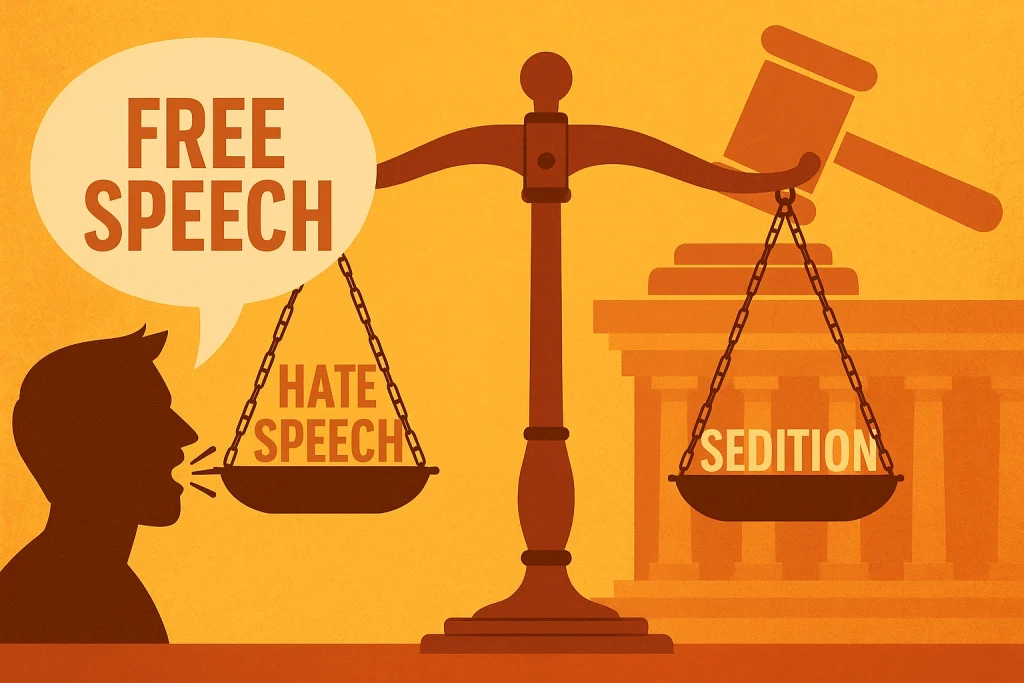
Free speech has always been both the hallmark and the test of a democracy. In India, the Constitution guarantees freedom of speech and expression under Article 19(1)(a)—a cornerstone of personal liberty and democratic participation. Yet this right is not absolute; it coexists with a set of reasonable restrictions under Article 19(2) designed to safeguard public order, decency, morality, sovereignty, and national security. In contemporary India, debates around hate speech and sedition have intensified, reflecting tensions between protecting national integrity and preserving dissent. This article explores how India defines and regulates hate speech and sedition, the constitutional tests applied by courts, and where jurisprudence attempts to draw the elusive “line” between legitimate dissent and punishable speech.
I. Constitutional Foundations: Speech and Its Limits
Article 19(1)(a) guarantees freedom of speech and expression. The Supreme Court has repeatedly held that free expression is vital to democracy, enabling citizens to critique the state and participate meaningfully in governance. In Romesh Thappar v. State of Madras and Brij Bhushan v. State of Delhi (1950), the Court invalidated pre-censorship orders, asserting that freedom of the press is essential to democratic health. Article 19(2) permits the State to impose reasonable restrictions in the interests of sovereignty, security, public order, decency, morality, contempt of court, defamation, or incitement to an offence. Restrictions must have a proximate nexus with one of these grounds and must satisfy the test of reasonableness and proportionality.
II. Hate Speech: The Fine Line Between Offence and Incitement
India lacks a single statute defining hate speech. Instead, it is regulated through provisions of the Indian Penal Code (IPC)—Sections 153A, 295A, and 505(2)—which penalise enmity, deliberate outrage of religion, and public mischief respectively. In Ramji Lal Modi v. State of UP (1957), the Supreme Court upheld Section 295A, clarifying that it applies only to deliberate and malicious acts. In Amish Devgan v. Union of India (2020), the Court held that hate speech must be judged by content, intent, extent, and context, distinguishing between advocacy and incitement. This interpretation aligns with the ‘clear and present danger’ test in global free speech jurisprudence, restricting only imminent threats to public order.
III. Sedition: A Colonial Relic in a Democratic Republic
Section 124A of the IPC criminalises speech that brings or attempts to bring into hatred or contempt, or excites disaffection towards the government. In Kedar Nath Singh v. State of Bihar (1962), the Supreme Court upheld sedition but limited it to speech that incites violence or public disorder. Mere criticism, however harsh, was excluded from its scope. Despite this, sedition continues to be misused against dissenters, journalists, and activists, often without evidence of incitement. In 2022, the Supreme Court stayed the operation of Section 124A, signalling a potential shift towards reform or repeal under the new Bharatiya Nyaya Sanhita framework.
IV. Drawing the Line: Free Speech vs Public Order
The proximity test guides Indian courts—restrictions must relate directly to public disorder. In Superintendent, Central Prison v. Ram Manohar Lohia (1960), the Court held that mere advocacy of disobedience is not enough; the speech must intend and likely cause immediate disturbance. In Shreya Singhal v. Union of India (2015), the Court struck down Section 66A of the IT Act for vagueness, reaffirming that subjective annoyance cannot justify criminal restriction.
V. The Role of Media and the Internet
Social media amplifies both free and hate speech. Intermediaries now bear responsibility under the IT Rules, 2021 to remove unlawful content swiftly. However, over-delegation to the executive risks chilling legitimate expression. The Bombay High Court in Kunal Kamra v. Union of India (2024) held that truth determination cannot rest with the government, reinforcing judicial oversight in regulating online speech.
VI. Global Perspectives and Comparative Lessons
Globally, democracies grapple with similar tensions. The U.S. First Amendment restricts only direct incitement to violence (Brandenburg v. Ohio, 1969). The U.K. criminalises stirring up hatred with intent, and Germany bans Nazi propaganda to protect democratic order. India’s model lies between these poles—broader than the U.S. approach but narrower than Europe’s, reflecting its plural and diverse society.
VII. The Road Ahead: Reform and Responsibility
The criminal law reform under the Bharatiya Nyaya Sanhita, 2023 offers an opportunity to modernise archaic offences. Sedition could be replaced with a narrower offence penalising acts that endanger sovereignty or unity through incitement or violence. Similarly, India needs a comprehensive, viewpoint-neutral hate speech law aligned with Article 20(2) of the ICCPR. Judicial vigilance, media responsibility, and civic education will remain key to ensuring that free speech thrives without enabling hate.
Conclusion
India’s constitutional journey on free speech, hate speech, and sedition reflects an ongoing tension between liberty and order. Courts have consistently reaffirmed that criticism is not sedition, offence is not hate, and disagreement is not disloyalty. The line lies where expression transforms into incitement of violence or hatred. The vitality of India’s democracy depends not only on judicial interpretation but on civic maturity and tolerance for dissent—the true test of freedom.
References
- Romesh Thappar v. State of Madras, AIR 1950 SC 124.
- Brij Bhushan v. State of Delhi, AIR 1950 SC 129.
- Ramji Lal Modi v. State of UP, AIR 1957 SC 620.
- Kedar Nath Singh v. State of Bihar, AIR 1962 SC 955.
- Superintendent, Central Prison v. Ram Manohar Lohia, AIR 1960 SC 633.
- Balwant Singh v. State of Punjab, (1995) 3 SCC 214.
- Shreya Singhal v. Union of India, (2015) 5 SCC 1.
- Amish Devgan v. Union of India, (2020) 15 SCC 461.
- Kunal Kamra v. Union of India, Bombay High Court, 2024.
- Government of India, Bharatiya Nyaya Sanhita Bill, 2023.
Quick Links
Have questions? email contact@vidhisamvad.com
Our support team is available Monday to Saturday from 8 a.m. to 8 p.m.