
October 15, 2025
ESG (Environmental, Social, Governance) Compliance in Indian Companies: Legal Obligations and Trends
Introduction
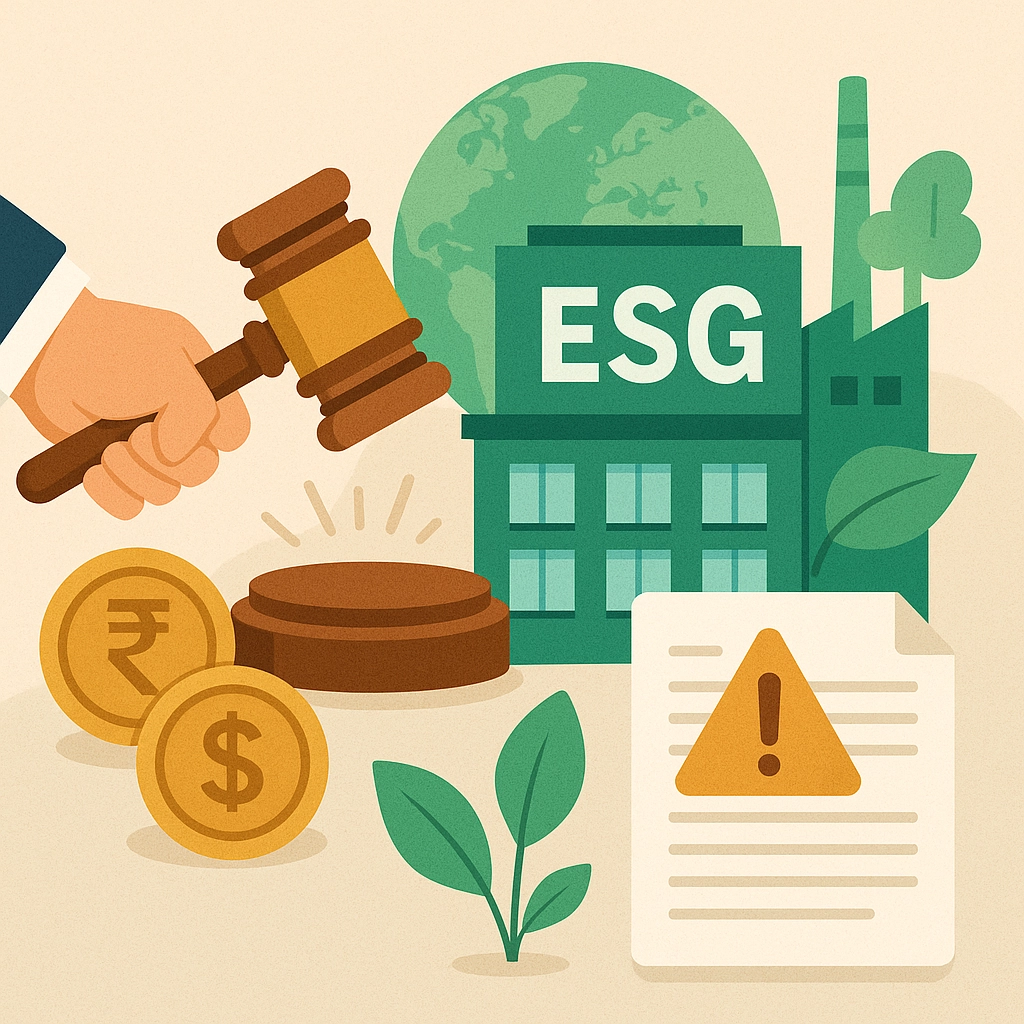
ESG has evolved from a voluntary disclosure practice to a regulatory requirement in India. The push for transparency, sustainability, and ethical governance is now embedded in India’s corporate compliance framework. From SEBI’s Business Responsibility and Sustainability Reporting (BRSR) mandate to the regulation of ESG Rating Providers (ERPs) and the rise of green bonds, India’s ESG ecosystem is becoming increasingly sophisticated. This article explores the legal foundations, obligations, and emerging trends shaping ESG compliance among Indian companies.
I. The Legal Foundation of ESG in India
India’s ESG regime is anchored primarily in the Securities and Exchange Board of India (SEBI) framework, which requires the top 1,000 listed entities by market capitalization to file annual Business Responsibility and Sustainability Reports (BRSR). Introduced in 2021, the BRSR replaced the older Business Responsibility Report (BRR) and aligns with the National Guidelines for Responsible Business Conduct (NGRBC) issued by the Ministry of Corporate Affairs in 2019.
The BRSR framework consists of quantitative and qualitative disclosures across nine principles, covering areas such as environmental stewardship, social impact, employee welfare, and governance practices. It is supported by SEBI’s circulars and amendments to the Listing Obligations and Disclosure Requirements (LODR) Regulations, which link ESG reporting directly to corporate governance standards.
II. BRSR Core and Assurance Mechanism
In 2023, SEBI introduced the ‘BRSR Core’, a set of standardized ESG metrics requiring limited assurance by an independent third party. These metrics focus on energy use, greenhouse gas emissions, waste management, water consumption, workforce diversity, and supply-chain performance. The BRSR Core is being implemented in a phased manner for the top 1,000 listed companies between FY 2023–24 and FY 2026–27, with assurance extending to value-chain partners in later phases.
This assurance framework enhances the credibility of ESG data and aligns Indian reporting practices with global standards like the GRI Standards and the Task Force on Climate-related Financial Disclosures (TCFD).
III. Regulation of ESG Rating Providers (ERPs)
Recognizing the growing influence of ESG ratings on investment decisions, SEBI released a regulatory framework for ESG Rating Providers in 2023. The framework mandates registration, conflict-of-interest disclosures, transparency in rating methodology, and grievance redressal mechanisms. In 2025, SEBI further issued norms for withdrawing ESG ratings and proposed a review of supply-chain disclosure obligations to ease compliance burdens while ensuring reliability.
IV. Substantive Legal Obligations Under the ESG Pillars
While ESG disclosures focus on transparency, the underlying compliance requirements are spread across multiple statutes. Each ESG pillar—Environmental, Social, and Governance—draws from existing Indian laws:
• Environmental: The Air (Prevention and Control of Pollution) Act, 1981, Water (Prevention and Control of Pollution) Act, 1974, and Environment (Protection) Act, 1986, impose emission and waste control norms. The EIA Notification under the Environment Act mandates environmental impact assessments for specified projects. Companies must also comply with the Plastic Waste, Hazardous Waste, and E-Waste Management Rules.
• Social: The Companies Act, 2013, through Section 135, mandates Corporate Social Responsibility (CSR) spending. Labour and social welfare are covered by the Code on Wages, 2019, and the Occupational Safety, Health and Working Conditions Code, 2020. The Sexual Harassment of Women at Workplace (Prevention, Prohibition, and Redressal) Act, 2013, further anchors social governance obligations.
• Governance: SEBI’s LODR Regulations require listed entities to maintain independent boards, risk management committees, and whistle-blower mechanisms. The BRSR framework integrates these requirements under Principle 1 and Principle 5, emphasizing ethical governance and stakeholder accountability.
V. ESG in Financial and Capital Markets
Sustainable finance has emerged as a crucial enabler of ESG adoption. In 2023, SEBI updated its framework for Green Debt Securities to include social, sustainability, and sustainability-linked bonds. These instruments require clear disclosure of use-of-proceeds, measurable impact indicators, and third-party verification. The surge in municipal green bonds, such as the oversubscribed Surat Municipal Corporation bond in 2025, reflects growing investor confidence in transparent ESG frameworks.
VI. Emerging Regulatory Trends
In 2025, SEBI initiated a comprehensive review of ESG disclosure and rating frameworks to streamline reporting burdens and avoid duplication. This includes refining value-chain disclosure obligations and harmonizing assurance standards under BRSR Core. The move aligns India’s regulatory trajectory with international efforts such as the International Sustainability Standards Board (ISSB) and the EU Corporate Sustainability Reporting Directive (CSRD).
VII. ESG Risk Management and Board Accountability
ESG is now embedded in enterprise risk management. Boards are expected to oversee ESG strategy, ensure compliance with BRSR Core metrics, and align disclosures with financial materiality. SEBI has encouraged companies to integrate ESG oversight within board committees and link executive compensation to sustainability performance.
Assurance of ESG data will soon resemble statutory audit processes. Audit committees must verify data integrity, monitor assurance providers, and reconcile sustainability and financial disclosures to avoid greenwashing claims.
VIII. Compliance Roadmap for Indian Companies
1. Conduct a materiality assessment aligned with NGRBC principles.
2. Strengthen environmental compliance through digitized monitoring of emissions and waste.
3. Update CSR policies to align with national and SDG goals.
4. Establish internal controls for ESG data collection and reporting.
5. Engage independent assurance providers for BRSR Core verification.
6. Map supply-chain partners and incorporate ESG clauses in contracts.
7. Disclose ESG-linked remuneration for senior management.
8. Build board capacity through ESG-focused training and reporting dashboards.
IX. Conclusion
ESG compliance in India is entering a phase of consolidation and accountability. Regulatory momentum from SEBI, the Ministry of Corporate Affairs, and global investors is transforming sustainability from a narrative to a measurable performance metric. Companies that embed ESG into their strategic DNA will not only meet compliance standards but also enhance resilience, investor confidence, and long-term value creation.
References
- SEBI Circular on Business Responsibility and Sustainability Reporting (BRSR), May 10, 2021.
- SEBI Circular on BRSR Core and Value Chain Disclosures, July 12, 2023.
- SEBI Framework for ESG Rating Providers, July 2023; amended norms, April 2025.
- Ministry of Corporate Affairs, National Guidelines for Responsible Business Conduct (NGRBC), 2019.
- Companies Act, 2013; CSR Rules, 2014.
- Air (Prevention and Control of Pollution) Act, 1981; Water (Prevention and Control of Pollution) Act, 1974.
- Environment (Protection) Act, 1986; EIA Notification, 2006.
- SEBI Green Debt Securities Framework, February 6, 2023.
- Surat Municipal Corporation Green Bond, 2025 (Market Reports).
- SEBI Review of ESG Disclosures and Rating Framework, April 2025.
Quick Links
Have questions? email contact@vidhisamvad.com
Our support team is available Monday to Saturday from 8 a.m. to 8 p.m.